Ski Jumping has been part of the Winter Olympics since the inaugural edition in 1924 and, ahead of the 2026 Games, we have provided a guide to the sport.
First Played | 1924 (2014 for women) |
Most Gold Medals (Athlete) | Matti Nykanen (Finland) 4 |
Most Gold Medals (Country) | Norway (12) |
2022 Gold Medal Winners (individual) | Men’s long hill: Marius Lindvik (Norway) Men’s normal hill: Ryoyu Kobayashi (Japan) Women’s normal hill: Ursa Bogataj (Slovenia) |
2022 Gold Medal Winner (team) | Men’s large hill: Austria MIxed normal hill: Slovenia |
Events
There are six gold medals up for grabs in ski jumping at the 2026 Winter Olympics.
Male competitors will do battle in two individual competitions on the large and normal hill while women will compete on the normal hill and, for the first time this year, the large hill as well.
Another new event this year is the men’s super team replacing the large hill team competition.
This will involve teams of ski jumpers who will battle over three rounds of jumps instead of two, with the top eight teams going through to the final.
A mixed team event with two male and female athletes competing over the normal hill will again take place having been introduced in Beijing four years ago.
How does Ski Jumping work?
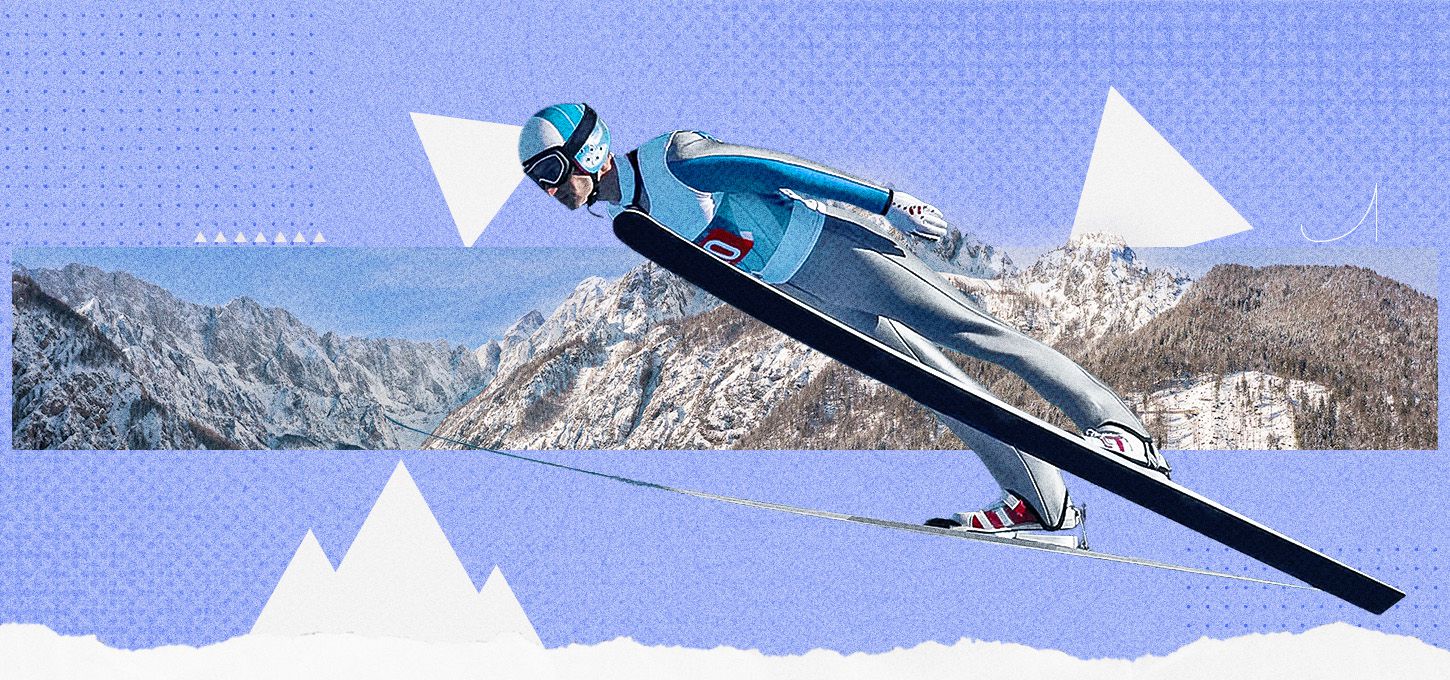
In ski jumping, jumpers descend down a curved ramp and aim to land as far away as possible, but it takes more than generating the longest leap to become an Olympic champion.
Competitors will also be marked by judges on the style with which they perform and key considerations will be made on such factors as the skis’ stability during the jump, the balance displayed, the body position of the jumper and, of course, the smoothness of that all-important landing.
In individual competitions, a trial run is conducted to decide the order with which the jumpers will descend and all 50 will start the competition. The top 30 will then qualify for the second round.
2026 Venues
The Ski Jumping at the 2026 Winter Olympics will take place at the Predazzo Ski Jumping Stadium, which was built in 1989 and hosted its first World Cup event in 1990.
It is used as a training base for the Italian national ski jumping and nordic combined teams and the state-of-the-art facilities include advanced floodlights that can accommodate evening events and, when not being used for competitions, it is open to the public.
Team GB History
Team GB Athlete with the most medals
Great Britain does not have an illustrious history in the sport of Ski Jumping and have never claimed an Olympic medal.
However, it was the sport of one of Britain’s most famous Winter Olympians as followers of the 1988 Games in Calgary, Canada became enthralled by the story of Eddie ‘The Eagle’ Edwards.
Edwards was the first British skier ever to take part in Olympic Ski Jumping and he became the epitome of the mantra that it is not the winning that matters but the taking part.
He was comfortably last in both the large and normal hill but he captured the hearts of millions of fans, if not the International Olympic Committee (IOC), who introduced stricter qualification rules to prevent others from following his example.
While Edwards failed to qualify for the Albertville Games in 1992 and Lillehammer in 1994, he remains a household name and one of the country’s most famous Olympians.
Glynn Pedersen subsequently qualified for the 2002 Games in Salt Lake City where he was 43rd in the normal hill and 48th in the large hill competition.
Facts & Trivia
Men’s ski jumping has been part of the Winter Olympics in every competition since the first Games in Chamonix in 1924, but the first women’s events were not introduced until 2014.
There are strict rules concerning clothing in the competition and competitors can be disqualified if their suits are not up to scratch. Strict rules regarding thickness are in operation and even a wrongly placed zip can cause potential Olympic heartache.
A maximum ski length is also in operation and they cannot be more than 145% of the competitors height. This is based on a competitors’ body mass index (BMI) of 21. If the jumper’s BMI is lower than 21, the skis have to be progressively shorter, in order to prevent lighter skiers having an advantage.
The key to gaining valuable points on the landing is to adopt the Telemark with one leg in front of the other. It’s not just about style, though. It’s the best way to absorb landing at 60mph.