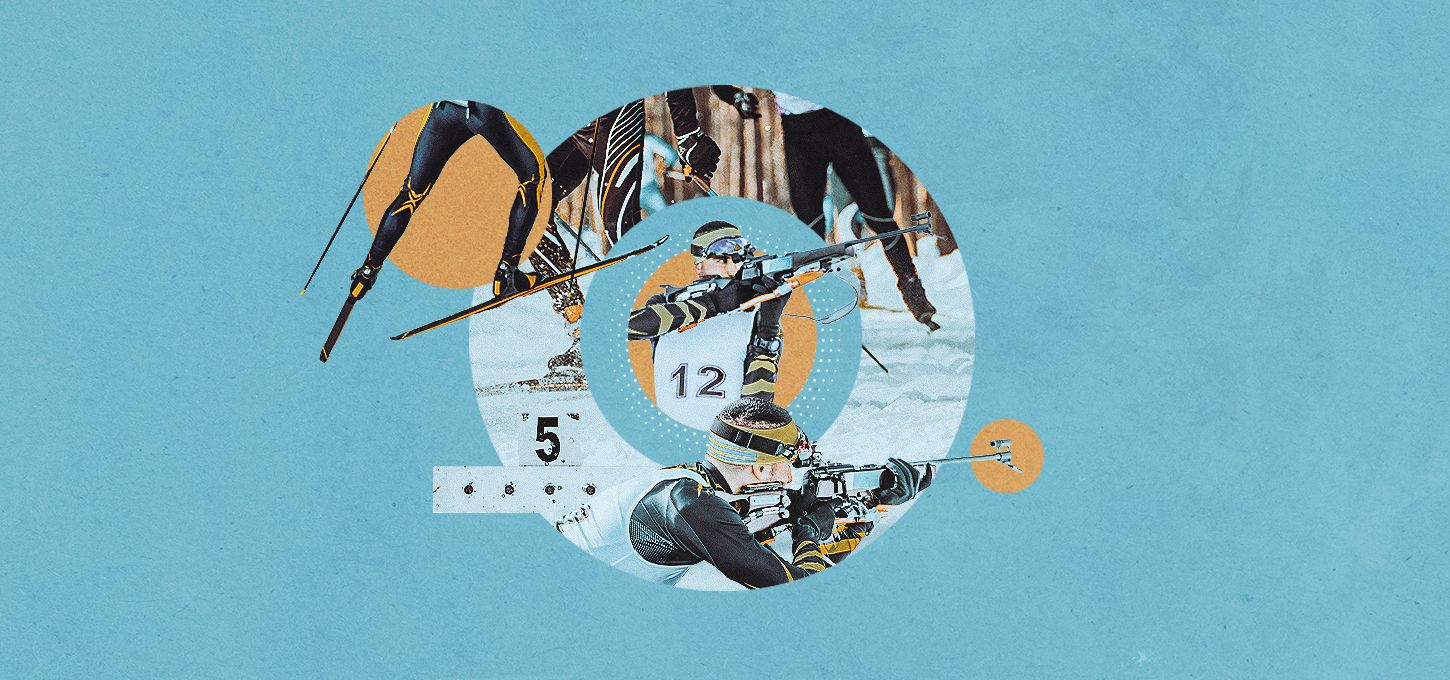
Originally known as military patrol, biathlon, which combines cross-country skiing with target shooting, has been a fixture at all 24 previous editions of the Winter Olympics.
As recently as 1988 there were only three biathlon events at the Winter games, but for the fourth time in a row there will be 11 biathlon races at Milano Cortina 2026.
Dates
The opening biathlon event of the 2026 Winter Olympics will see both the male and female athletes in action as they contest the 4x6km Mixed Relay on Sunday 8th February, and the programme concludes with the 12.5km Women's Mass Start on Saturday 21st February.
Events
There will be a total of 11 biathlon races across the programme, five each for the men and women as well as the Mixed Relay.
Mixed event
Mixed Relay 4x6km
Men's events
Men's 20km Individual
Men's 10km Sprint
Men's 12.5km Pursuit
Men's 4 x 7.5km Relay
Men's 15km Mass Start
Women's events
Women's 15km Individual
Women's 7.5km Sprint
Women's 10km Pursuit
Women's 4 x 6km Relay
Women's 12.5km Mass Start
Format
Biathlon sees competitors skiing laps of a cross-country circuit, with each lap ending with a trip to the rifle range to shoot five targets.
In the first (and in longer races also the second) visit to the range athletes fire their .22 calibre rifles from a prone (lying down) position, while later laps end with shooting from standing position.
The targets are placed 50m from the shooting mats, and prone targets are roughly the size of a golf ball, while standing targets, as this position is more difficult, are about the size of a grapefruit.
Relay
Olympic relays feature teams of four competitors. Each skis three laps of the circuit, shooting once from prone and once from standing position before handing over to the next member of their team. The teams begin the race from a starting grid and compete head-to-head with the first over the finishing line the winner.
Individual
This is the longest distance race on the programme and is raced against the clock. Competitors begin one at a time, at intervals, and ski five laps, with two prone shoots followed by two standing shoots. The winner is the athlete with the fastest overall time, including penalties (discussed below).
Sprint
Similar to the individual, but this event features just one prone and one standing shoot. Sprint times are used effectively as qualifying for the Pursuit.
Pursuit
This is a head-to-head race but the competitors set off at intervals determined by their finishing time in the Sprint. The Sprint winner sets off first. If, for example their Sprint time was 10 seconds faster than the silver medalist, then that athlete would hit the course 10 seconds later. If the Sprint bronze medalist was a further 15 seconds behind, they begin 15 seconds after the second athlete, and so on.
Mass Start
The best performing athletes across the preceding races qualify for the Mass Start, a four-shoot head-to-head race.
Penalties
The penalties for a missed target vary depending on what the race is.
In relays only, competitors carry three spare rounds of ammunition per lap, and they are permitted to reload these if they miss a target. Missing more than three times means there are not enough bullets to hit all the targets, and a 150m penalty loop, located just after the exit from the range, must be skied for every target left standing.
In the Individual, each missed shot adds a minute onto the competitor's time. That is a severe penalty, so athletes tend to take more time over their shots in this event.
In each of the Sprint, Pursuit and Mass Start, missing each target means the athlete must ski one lap of the 150m penalty loop, which typically takes around 20 seconds.
Venues
Antholz-Anterselva's South Tyrol Arena will be a familiar sight to all the Olympic biathletes, as the venue hosts a regular January meeting on the World Cup circuit.
The most northerly venue at the 2026 Winter Olympics, just over the Austrian border, Antholz has capacity for 3,000 spectators, but 23,000 lined the route for the 2007 World Championship.
History
Biathlon has been a part of all 24 previous Winter Olympics, although for the first four editions it was known as Military Patrol.
The 1968 games saw a relay join the individual competition on the programme, while in 1980 a 10km Sprint was added.
Women's events were included for the first time in 1992 and the addition of the Mixed Relay at Sochi 2014 took the number of races up to the current tally of 11.
Team GB biathlon prospects
Team GB returns to Olympic biathlon in 2026 after not having any representation at Beijing 2022.
Jacques Jeffries was born in France to British parents, and the 23-year-old former Junior World Champion has a best finish of 53rd on the World Cup circuit this season. That was enough to qualify him for the Pursuit race in the season-opening Annecy event.
Jeffries is joined by 23-year-old Shawna Pendry, who finished 12th in the Women's Sprint at the 2020 Winter Youth Olympics. She has made three appearances on the World Cup tour this season, with a best finish of 72nd.
Team GB biathlon medals
Keith Oliver achieved Team GB's best result in Olympic biathlon when he finished 11th in the 20km Individual at the 1972 games in Sapporo, Japan.
Britain was relatively well represented in the sport during the 1980s with Oliver, Jim Wood and Mike Dixon recording top-20 finishes.
Jeffries and Pendry's presence means GB has two representatives for the first time in 12 years, as Amanda Lightfoot was the sole Team GB entrant at Pyeongchang 2018.