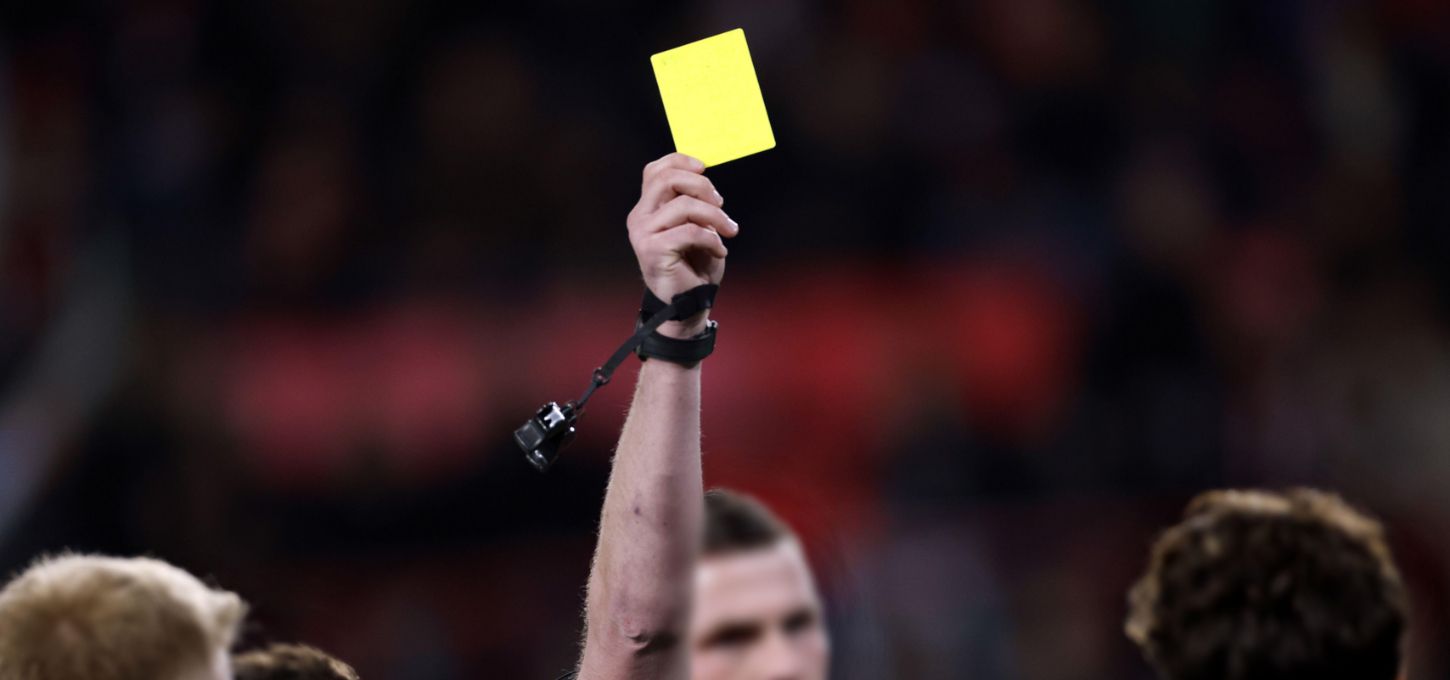
The yellow card is a crucial tool in the governance of football and are used by a referee to indicate when a player or a team official has been officially cautioned.
Although a single yellow card does not result in a player being removed from the game, accumulating a number of yellow cards can have consequences down the line.
To clamp down on repeat yellow card offenders, the Premier League and Football League have guidelines in place which can result in suspension if a player reaches the threshold after a specific number of matches.
Premier League yellow card suspension rules explained
Players in the top-flight automatically receive a one-match ban for accumulating five yellow cards in their side's first 19 matches of a Premier League campaign.
Should players avoid five yellow cards in that period, the ban increases to 10 yellow cards. Players must not accumulate 10 yellow cards before the conclusion of their side's 32nd match or they will receive a two-match suspension.
Any player that clocks up 15 yellow cards over the course of a Premier League campaign will receive an automatic three-match suspension.
Suspensions do not carry into other competitions and are consigned solely to the Premier League.
Football League yellow card suspension rules explained
The Football League adopts an identical 5, 10 and 15 yellow card approach to the Premier League, except as the season is longer in the Championship, League One and League Two, the deadline to avoid 10 and 15 yellow cards is also longer.
EFL rules indicate that any player who accumulates five yellow cards before the conclusion of their side's 19th match must serve a one-game ban.
The limit is subsequently increased to 10 yellow cards, which players must avoid by the end of the 37th match of the season or face a two-match suspension, while 15 yellow cards during the duration of the season will result in an automatic three-match suspension.
Suspensions do not carry into other competitions and are consigned solely to whichever aforementioned league the player is competing in.