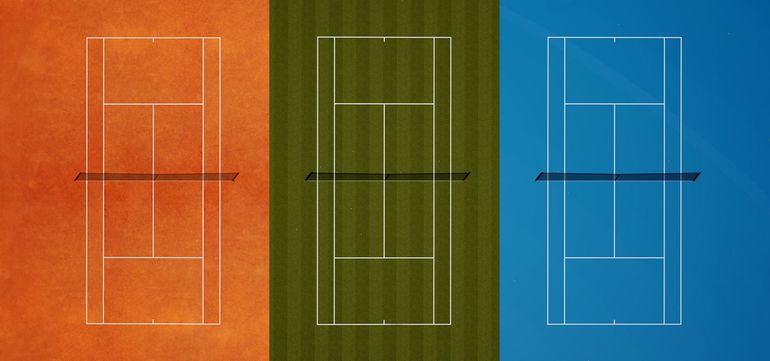
The Australian Open, French Open, Wimbledon, and the US Open are all unique in there own ways. However, there is one big difference, the type of court surface.
Here is an overview of tennis court surfaces, what makes them different, and everything you need to know about them.
Hard Courts
The Grand Slam tennis season kicks off and ends on hard courts - the most popular court surface in North America. These courts are best in the winter, summer, and fall.
They are made with concrete or an asphalt base coated with acrylic to provide cushioning. Hard courts are the happy medium between the quickness of a grass court and a slow clay court.
Hard courts are considered the best year-round surface because of their durability and low-maintenance requirements. Regardless of the season, hard courts offer consistent ball bounce.
Hard courts favor all types of tennis player styles, heavy-hitters with fast-paced play tend to excel on hard courts. An example would be Serena Williams, who has dominated at both the Australian Open and US Open which are both played on hard courts. Her aggressive playing style and ability to use the hard court to her advantage makes her hard to beat.
Red Clay
Clay courts are made with crushed brick and other loose minerals. You most likely recognize these red clay courts from Roland-Garros, the French Open. The crushed gravel, limestone, and brick give the court the distinctive red coloring.
Clay courts are popular in Europe and Latin America, optimal play is in the spring. They are also considered more player friendly because they are not as hard on your knees compared to hard courts.
Clay courts typically slow down ball speed and make the ball bounce higher. Creating a more challenging environment because of its unpredictability with every bounce.
A significant difference is clay courts allow players to slide to the ball rather than only sprint. There are different shoe requirements on clay courts since the gravel impacts how players approach the ball. The slide is something many players practice ahead of the French Open, if done correctly it can help save a shot.
Grass Court
Wimbledon is renowned for their pristine grass court. The summer is the optimal time to play on a grass court because the weather greatly impacts the course conditions. Grass courts are most popular in the United Kingdom. It is a requirement to wear flat-sole shoes at Wimbledon to avoid damaging the court.
A grass court typically plays fast compared to other surfaces, but weather plays a major factor. Hot weather makes the court fast and dry, while rain or humidity slows it down. The ball doesn't bounce as high on grass which is why players try to stay low and ready to move.
The grass at Wimbledon is 100% perennial ryegrass. It is cut to 8mm to maintain a fast, dense, and consistent playing surface. Natural grass courts are considered the most expensive and difficult to maintain.
Roger Federer and Martina Navratilova were regular victors on Wimbledon's grass courts.