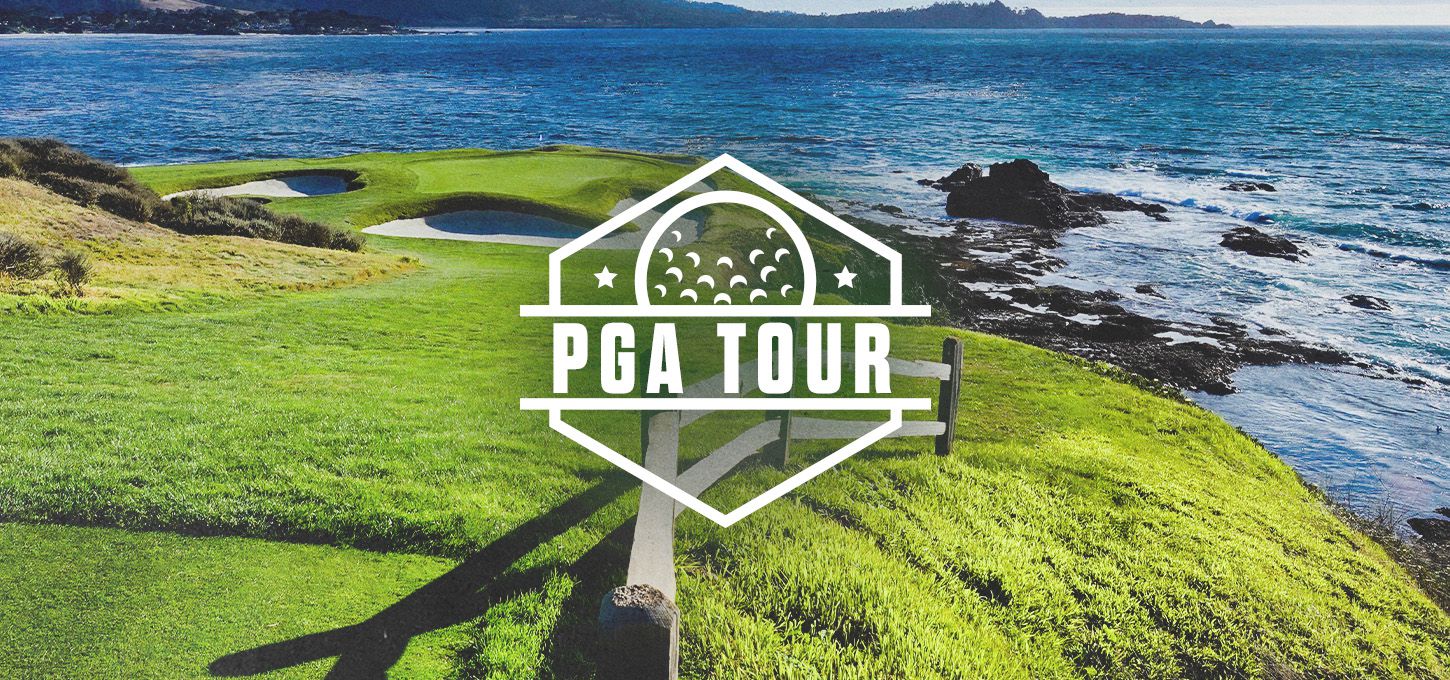
Pebble Beach Golf Links is the unanimously rated the No. 1 public golf course in the United States, and has hosted six U.S. Open Championships over the last 50 years.
Pebble Beach is known for its small green sizes. Greens on the course average 3,500 square feet, which is the smallest on the PGA Tour.
The course itself meets the Pacific ocean at Carmel Bay, and waves crash feet away from tee boxes and greens. The ocean is particularly close on the seventh hole.
Pebble Beach is a unique and classic course that rewards accuracy and precision rather than smashing a driver on every hole.
Pebble Beach Golf Links is a par-72 course (36-36). The course also hosts the PGA Tour AT&T Pebble Beach Pro Am every year, beginning in 1947.
Hole-by-Hole Highlights
Hole 1
378 yards
Par 4
The opening hole bends slightly to the right, and is lined by by buildings on both sides. As soon as the hole turns their are two bunkers on the left edge of the rough that players must avoid for an easy shot at the green.
Bunkers line the left and right side of of a skinny green that slopes back to front.
Hole 2
509 yards
Par 5
The second hole is long and straight, making it relatively easy to find a birdie for the pros.
The second green is protected by narrow trees in the front and bunkers on both sides.
Hole 3
397 yards
Par 4
The third flies roughly 250 yards before meeting the fairway and angling to the left. Three large bunks are in play to the back of the fairway, but playing to far right can meet a patch of trees, so hitting the fairway is important on the third.
From the fairway, the green is manageable. A large bunker protects the left side of the green, but you can't play too short to the right either because two more bunkers lurk below the elevated green.
Hole 4
333 yards
Par 4
Hole 4 climbs uphill along the oceanside cliffs off to the right, to one of the smallest greens in the game.
Multiple bunkers scatter the the side and middle of the fairway, so hitting for accuracy rather than distance on this hole is typically rewarding. The green is quite small, and is circled by three long bunkers.
Hole 5
189 yards
Par 3
The fifth hole at Pebble Beach is the newest hole on the course, and was built by Jack Nicklaus in 1998. The hole looks out across Stillwater Cove.
Three bunkers on the right side of the green actually protect golfers from the Pacific Ocean on the right.
Hole 6
498 yards
Par 5
The sixth is elevated above the salty water below the cliffs on the right. Players would typically looks to steer clear of the water, but five bunkers line the left side of the fairway forcing golfers to play for accuracy.
It the middle of the fairway, a steep hill climbs four stories up, with five more bunks hiding at the top.
Once players reach the higher portion of the fairway, the green is relatively easy target, but hitting the fairway twice is not an easy task.
Hole 7
107 yards
Par 3
Hole 7 at Pebble Beach is one of the most famous par-3s in the world. The 107 yards hole plays incredibly different depending on the speed and direction of the wind - Aces have been made with clubs ranging from a lob-wedge to a 3-iron.
The Green sits on a peninsula surrounded by crashing ocean waves. If you miss the green and the three bunkers surrounding the green, the ball will likely find itself amongst the fish.
Hole 8
416 yards
Par 4
Jack Nicklaus called the 8th his favorite par-4 in golf. The hole angles slightly to the right after crossing an ocean cove.
The fairway runs out of room above the cove at about 240 yards, so most players choose to lay up and hit their second towards the green.
Hole 9
483 yards
Par 4
One of the deepest bunkers on the course lurks on the left side of the fairway. If drives can reach bunkers distance but stay if the fairway it can rolls further towards the green.
The green is not well protected by bunkers with just one to the left, but Carmel Beach lies just to the right.
Hole 10
444 yards
Par 4
Four boasts the widest fairway on the course, and it sloes away from the large bunkers on the left side.
The green is wide open in the front, but the back is surrounded by a large bunker.
Hole 11
370 yards
Par 4
The 11th heads back inland, not to return to the shore again until 17.
The hole climbs uphill, creating a blind shot to the fairway that leads to multiple misses. The green is protected by bunkers on nearly all sides.
Hole 12
202 yards
Par 3
Hole 12 only has one small entry to the green, and bunkers surround all other side of the unforgiving green.
Hole 13
401 yards
Par 4
14 has been widened in recent years by clearing trees, making it much for forgiving.
The hole plays uphill, and is one of the few holes that the best play is to go for distance rather than accuracy.
Hole 14
559 yards
Par 5
The longest hole on the course, nearly no golfer will be able to hit the green in two shots.
The hole doglegs to the right, then climbs uphill making for a blind tee shot. Two bunkers protect the green in the front, and the green - which slopes back to front - falls offs down a steep slope to the back.
Hole 15
393 yards
Par 4
This hole is one of the easiest on the course, but it gets much more difficult in an errant shot finds itself in one of the many fairway bunkers that line both sides.
The green is relatively flat, so birdies are common on 15.
Hole 16
400 yards
Par 4
Another dogleg right, 16 has a very skiing fairway that makes most golfers keep the driver in the bag and opt for a wood.
Trees guard the entrance to the green which has a sleep slant from right-to-left. Favoring the right side of the green also keeps the ball away from protective bunker on the left.
Hole 17
182 yards
Par 3
This par 3 finds its way back to the sea.
A large hourglass-shaped green is covered by one large bunker to the left, and five smaller ones on the right.
Pin locations on the front of the green make for lots of birdie opportunities, but if its near the back, the bunkers become trickier to navigate.
Hole 18
541 yards
Par 5
The final hole hugs the ocean, bendy around the water to the left.
Hitting the green in two is difficult, but becomes even when a drive meets either of the two bunkers on the right side of the fairway, or if a shot finds itself behind an errant tree.
Reaching the green in two takes risk with bunkers all around the green, but the reward can be worth the risk especially on the final hole of the day.