What do yellow and red cards mean? Here, you can learn all about the rules, suspensions, and the history of cautions in soccer.
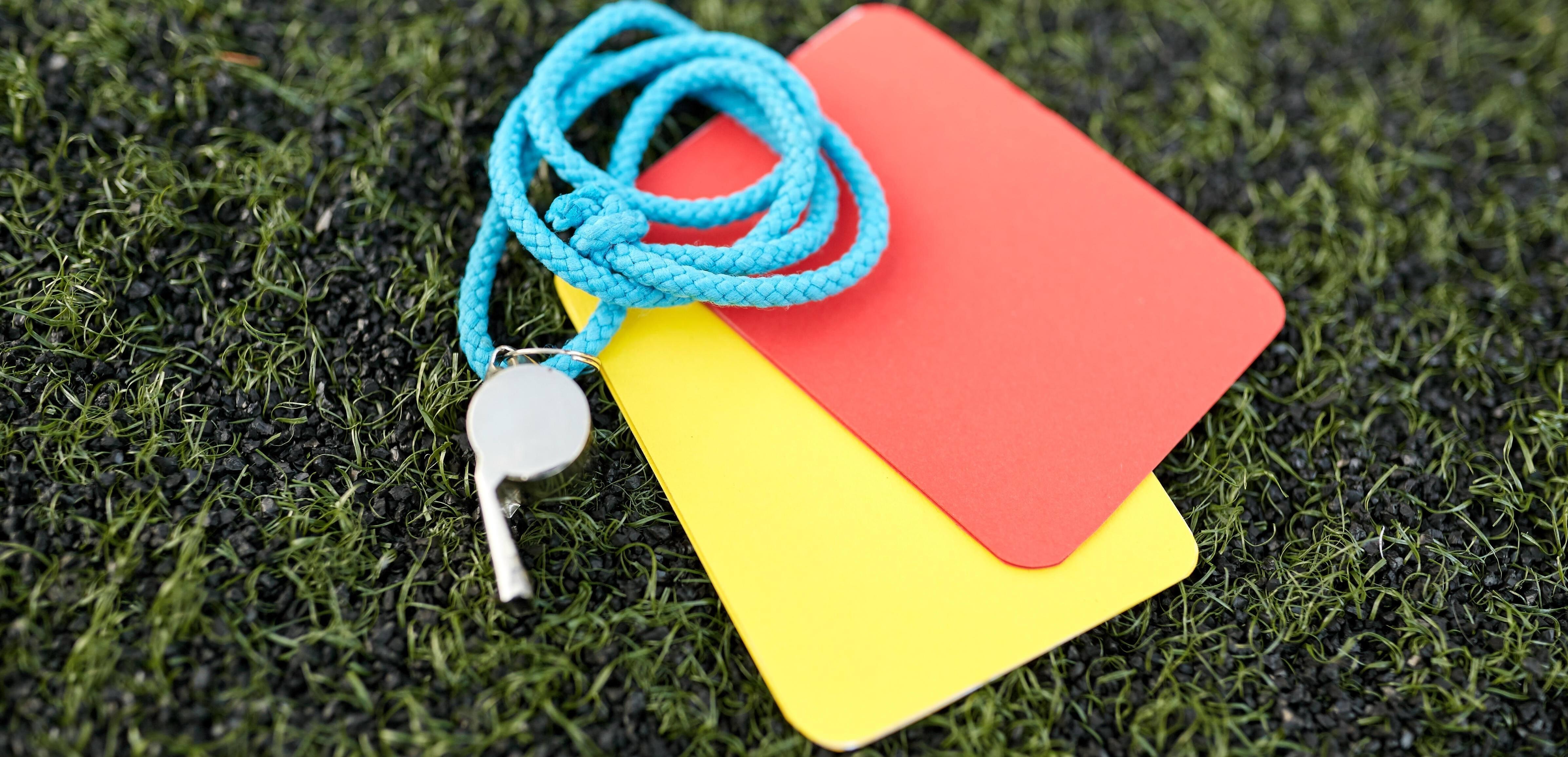
Yellow and red cards are ubiquitous in modern soccer, providing referees with a clear, universally understood method to discipline players, team staff, and bench personnel in full view of everyone in the stadium and watching at home.
Yet, the disciplinary card system has not always been a feature of the beautiful game. Introduced decades after the codified rules of association soccer were established, the system transformed how match officials control the pitch.
The History of Yellow and Red Cards
The concept of disciplinary cards was created by English referee Ken Aston. Following widespread confusion during the 1966 FIFA World Cup—where language barriers often left players and spectators unsure whether an official caution had been issued—Aston sought a universal visual solution.
Inspired by traffic lights, Aston proposed a simple colour-coded system:
🟨Yellow: Caution / Take care
🟥Red: Stop / Off the pitch
FIFA officially introduced yellow and red cards at the 1970 World Cup in Mexico, and they quickly became the global standard across all levels of the sport.
What Triggers a Yellow Card?
🟨 A yellow card acts as a formal caution. It signals that a player has committed an infraction and risks being sent off if they commit another serious offense during the match. Common offenses include:
Reckless challenges and standard foul play
Persistent infringement of the rules
Dissent or arguing with match officials
Unsporting behaviour
Time-wasting and deliberately delaying restarts
Removing a jersey while celebrating a goal
Failing to respect the required distance on free-kicks or throw-ins
The Second Yellow: What Happens Next?
🟨🟨 If a player receives two yellow cards in the same match, the referee produces a second yellow followed immediately by a red card.
🟨🟥 The player must leave the pitch immediately and cannot be replaced, forcing their team to play the remainder of the fixture with a numerical disadvantage. A second-yellow dismissal typically carries an automatic one-match suspension.
When Does a Referee Show a Straight Red Card?
🟥 A direct red card signals an immediate sending-off for severe misconduct. As with a double-yellow dismissal, the penalized player cannot be substituted, leaving the side short-handed. Direct red cards are issued for serious infractions, including:
Serious foul play and reckless tackles that endanger an opponent's safety
Violent conduct, such as striking an opponent
Spitting or biting
Using offensive, insulting, or abusive language and gestures
Denying an obvious goal-scoring opportunity (DOGSO)
Suspension Lengths for Red Cards
The duration of a ban following a direct red card depends on the severity of the offense and the specific competition's disciplinary code. Typical guidelines include:
Denying a goal-scoring opportunity: Generally a one-match suspension.
Serious foul play: Usually carries a two-to-three-match ban.
Violent conduct and assault: Often results in multi-match suspensions, with severe cases leading to multi-month bans.
Independent disciplinary panels and governing bodies review match reports and can extend suspensions for particularly egregious actions.
Yellow Card Accumulation Rules
🟨🟨🟨🟨🟨 In addition to single-match dismissals, soccer leagues enforce suspension rules for players who accumulate yellow cards over the course of a campaign:
Domestic Leagues: In club competitions, a player serves an automatic one-match ban upon collecting five yellow cards, with further suspensions triggered at milestones like 10 and 15 cautions.
International and European Tournaments: In tournaments like the UEFA Champions League and the FIFA World Cup, players often face a one-match ban after accumulating three cautions.
To avoid players missing the showpiece match purely on cumulative cautions, major tournaments typically reset yellow card tallies after the quarter-final stage. However, any player sent off via a red card or a second yellow in a semi-final will still miss the final.
Who Else Can Be Booked?
Disciplinary authority is not restricted to the eleven players on the pitch. Modern rules permit referees to issue yellow and red cards to substitutes, managers, assistant coaches, and other technical staff on the bench for irresponsible or unsporting behaviour in the technical area.
Discover more from bet365
Read the latest soccer news on site.
This article was written in German by sports writer Kim Klos, and translated to English.