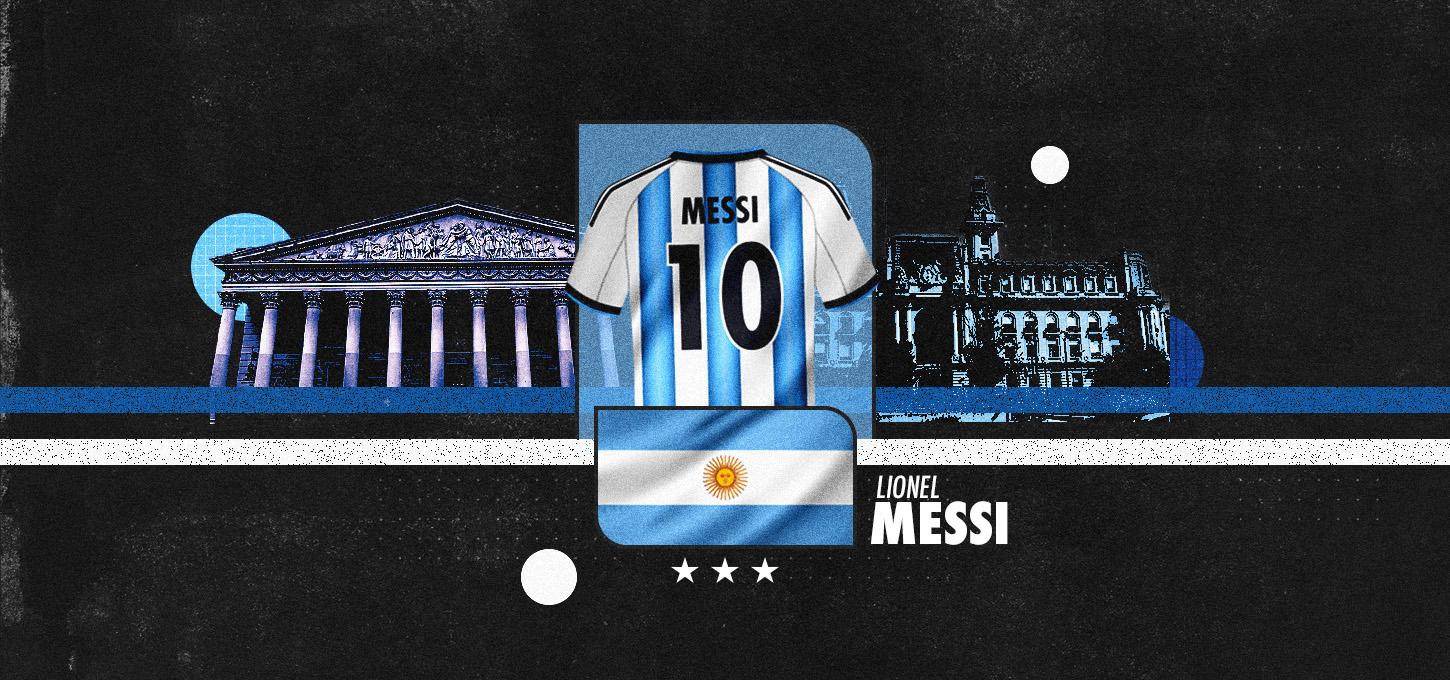
Both diminutive, playmaking number 10s who could dribble past players in a phone box and the scorers of some of the most iconic goals in football history.
Both winners of the FIFA World Youth Championship for Argentina, and both even made their international debut against Hungary.
You can add to the comparison by noting they both made their name at club level with Barcelona.
Of course, their history with Barcelona is where the stories of Diego Maradona and Lionel Messi split into different paths.
Maradona spent five years with Argentinos Juniors and a year with Boca Juniors, and had played dozens of games for Argentina at youth and senior level before leaving for bigger things.
While in Europe, Maradona led Argentina to the 1986 World Cup, immortalising himself as a national icon.
For Messi, his path was different. Diagnosed with growth hormone deficiency as a child, Messi’s footballing future in Argentina became untenable, leading to a move to Barcelona at the age of 13.
It was the first significant point of difference between Maradona and Messi; Argentines often accused Messi of not being Argentine enough, in part due to the early age at which he left his homeland. Messi would also be criticised for not singing the national anthem.
While Maradona was a larger-than-life character, whose off-field issues actually endeared him to the public, Messi was much more introverted. His lack of overt passion was perceived as a lack of patriotism.
Argentinians have always liked the fiery, chest-beating patriots, footballers who’ll run themselves into the ground, playing right on the edge and not afraid to cross the line. Messi’s football is the antithesis; raw technical ability, so much so that managers would allow him to amble around the pitch, negating defensive duties and waiting for the opportunity to strike.
While that worked for Barcelona, it didn’t for Argentina.
The New Maradona
Still new to the national team, Messi made his first World Cup appearance in 2006, starting Argentina’s final group game having already qualified for the knockout rounds. Messi was introduced as a substitute against Mexico but was unused for the quarter-final with Germany, losing on penalties.
At this time, Argentinians wanted to see more of the exciting Messi, who’d been overlooked for Julio Cruz. Messi wouldn’t be overlooked much longer.
By the time of the 2010 World Cup four years later, Messi was the Ballon d’Or holder, expected to follow in now-coach Maradona’s footsteps.
But Maradona the coach was not Maradona the player, and despite impressive individual performances, Messi was powerless to stop another premature exit, once again being knocked out by Germany, this time via a 4-0 defeat.
Remarkably, Messi had gone more than two years without a competitive goal for the national side, and the earlier goodwill afforded to the talented youngster was evaporating amongst the Argentine public. Messi was no longer the talented youngster, but the best player in the world, expected to carry the side as Maradona once did.
Messi fared no better at the 2011 Copa America on home soil, and was booed by his home supporters for the first time with La Albiceleste crashing out on penalties at the quarter-final stage to Uruguay.
By the time the 2014 World Cup rolled around, Messi had now won four Ballons d’Or, and expectations for Argentina were high again. The group stage was all Messi, scoring four of their six goals, seemingly rounding into form perfectly for the knockouts.
But when his country most needed him, Messi was found wanting. Argentina reached the final and yet scored just two goals in the knockout stages, with Messi failing to find the net. Messi was even put through on goal in the final, but whipped his effort wide past Manuel Neuer’s far post.
There were no excuses; Germany won fair and square. Maradona had no excuses in 1986 – he simply went and picked his nation up and carried them on his back to World Cup glory.
More World Cup heartbreak
Messi, the best player in the world who’d won the lot with Barcelona and four times been crowned the world’s best footballer, could never replicate his form for the national side. Criticism about not being Argentinian enough could be put to one side; Messi simply wasn’t delivering the results for Argentina that he was for Barcelona, in his adopted home.
The Copa America offered little reprieve. Messi would make finals again in 2015 and 2016 and despite excellent performances throughout, two more penalty shoot-out defeats extended Argentina’s trophy-less streak to 23 years.
The Argentina shirt seemed to be weighing too heavily on Messi. While many had been billed as the heir to Maradona’s throne, Messi was his one true successor. He also felt unloved by too many Argentina fans, prompting Messi to announce his retirement after the 2016 Copa America. If it was a bluff, Messi wasn’t called on it.
Messi suggested that people wanted him to retire. It forced fans to turn out and show their support and love for Messi – who was becoming increasingly unloved – or lose the best player in the world, in what would be a monumental act of self-sabotage. It then gave Messi the opportunity to announce his desire to continue, flying in the face of those who said he simply didn’t care.
By the time of the 2018 World Cup, Messi was 31 years old. It was not inconceivable that this was his last hurrah. It was perhaps the weakest team Messi had been a part of, but given what Maradona achieved in 1986, that wouldn’t be used as a mitigating factor.
Argentina weren’t particularly impressive in Russia, and despite briefly holding the lead against France, they’d go down 4-3 in what turned out to be the game of the tournament.
Messi, who’d be 35 at the next World Cup, had surely seen his best chances of international success come and go.
International success, at last
Somewhat ironically, it wasn’t until Messi’s Barcelona contract expired that he finally won silverware with Argentina, winning the 2021 Copa America, and while it wasn’t a World Cup, Messi’s perception with Argentina fans was shifting.
Less the shy, reluctant leader, the older Messi became a more passionate, more vocal captain, shining at the 2021 Copa America and ending a 28-year drought.
After years of turbulence in the dugout, Argentina were settled with Lionel Scaloni, who took over in the aftermath of the 2018 World Cup, and found a way to platform Messi to the best of his abilities.
A shock defeat to Saudi Arabia in their opening game cast significant doubts on Argentina’s hopes of winning a third World Cup, but the remainder of the tournament was Messi at his very best.
Messi would score and assist against Mexico in their second game, and despite having a spot-kick saved in their final group game, Argentina progressed to the knockout stages.
Sixteen years from his World Cup bow, Messi would finally score a knockout stage goal when giving Argentina the lead against Australia. A goal and assist followed in the quarter-finals against the Netherlands, only for the Dutch to pull off a dramatic comeback to force extra-time and penalties.
La Albiceleste never looked like losing the shootout and a semi-final with Croatia awaited. Again, Messi gave Argentina the lead before laying on an assist we’ve seen countless times before. Picking the ball up on the right wing, Messi turned Josko Gvardiol inside out, teeing up Julian Alvarez for his second and Argentina’s third.
Another World Cup final beckoned.
Messi, for the third time in the knockouts, gave Argentina the lead, and though they threw another two-goal lead away late on, Argentina emerged victorious on penalties in what was one of the greatest games of football ever played. When his team – his country – most needed him, Messi stepped up, again and again.
Nobody can ever overtake the status of the God-like Maradona in Argentina, not even the greatest player to play the game.
But after years of scorn from his fellow countrymen and more than a decade of international failure, Messi finally took his place amongst Argentina’s greats, and inside Argentinian hearts.
Lionel Messi's international career
International caps | 207 |
International goals | 125 |
International honours | Copa America x2, World Cup |
International debut | 17th August 2005 (v Hungary) |